
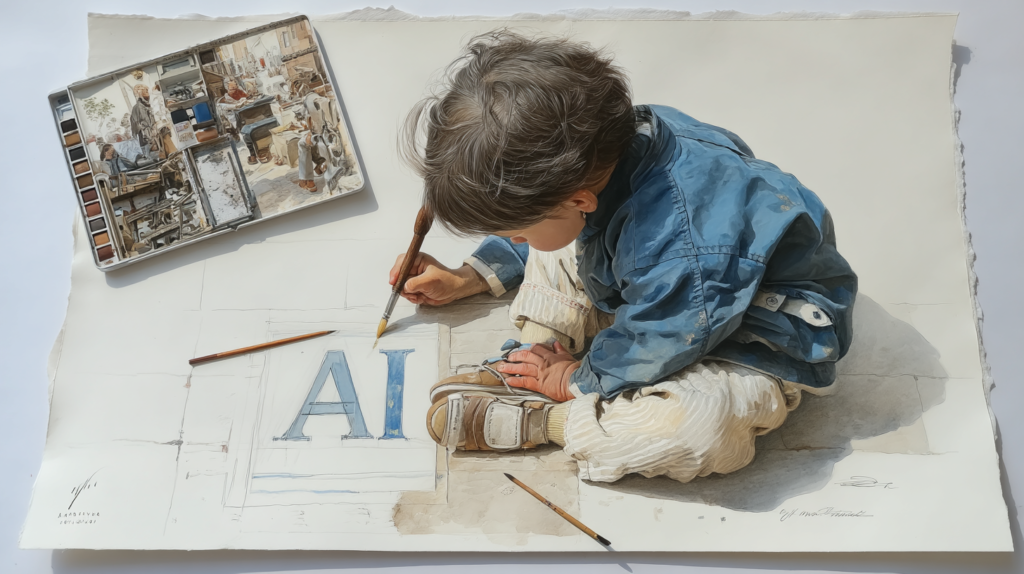
Just a few years ago, your job had a certain clarity to it, almost a physical presence you could point to. A factory closed, a company downsized, a manager made a decision that, however unpleasant, remained human and therefore explainable. Today, the threat has become far less visible and far more abstract, as if your livelihood could slowly dissolve not because of a single event, but because of a system quietly improving in the background. You are no longer competing with another person who just might be better; you are competing with a process that does not tire, negotiate, or hesitate. It is less like losing a race and more like discovering that the race has been automated while you were still tying your shoes.
Psychologists now refer to this diffuse unease as technological unemployment anxiety, a term that captures the growing stress people feel when they suspect their skills may not age particularly well in a world shaped by artificial intelligence. Unlike traditional job insecurity, which tends to arrive with a warning sign or a moment of disruption, this form of anxiety settles in early and lingers without resolution. You can be fully employed, reasonably competent, and still feel as if your professional identity has an expiration date written somewhere just out of sight. The uncertainty becomes the main character.
Anxiety Without an Event
One of the more unsettling aspects of this phenomenon is that it does not require anything to actually happen. There is no dismissal, no crisis, no obvious trigger that would justify the emotional weight it carries. Instead, it operates through anticipation, quietly projecting possible futures in which your relevance has diminished or disappeared altogether. Psychologists describe this as anticipatory stress, a condition in which the mind rehearses outcomes that have not yet occurred but feel increasingly plausible with every passing headline about automation and AI breakthroughs.
This creates a peculiar kind of tension, because there is nothing concrete to respond to and no clear timeline for resolution. The anxiety does not peak and subside in the way traditional stress often does; it lingers as a background hum, always present but rarely loud enough to demand immediate action. It is like having a question open in your mind that refuses to close, one that asks not whether something will change, but whether you will still matter when it does.
The Algorithmic Mirror
There is something uniquely personal about the idea of being replaced by a machine, something that extends beyond practical concerns and into the territory of identity. When another human outperforms you, it is possible to frame the outcome in familiar terms by attributing it to talent, effort, or experience. When an algorithm does the same, the conclusion feels less negotiable, as if your abilities have been translated into something measurable and quietly optimized away.
Researchers sometimes describe this as algorithmic anxiety, a subtle but persistent sense that your value can be reduced to a set of functions that no longer require your presence. It is not just the potential loss of a role that unsettles people, but the implication that the role itself may never have been as uniquely human as they believed. In this sense, AI acts less like a competitor and more like a mirror, reflecting a version of your work that appears efficient, scalable, and, unfortunately, replaceable.
The Expanding Target Zone
For a long time, there was a comforting assumption that automation would politely begin with repetitive, low-skill labor and leave more complex, cognitive work untouched. That assumption has not aged particularly well. Modern AI systems are capable of drafting legal documents, writing code, analyzing large datasets, and even producing convincing imitations of reflective writing, which has forced a broader range of professionals to reconsider their position.
As a result, the circle of perceived vulnerability has expanded, bringing white-collar workers into the same psychological territory once occupied primarily by manual laborers. The difference is not like the anxiety, but in its presentation, which tends to be quieter, more internalized, and occasionally dressed up as curiosity about “future trends.” Beneath that curiosity, however, there is often a more direct question waiting patiently: how safe is any of this, really?
Students Are Already Worried
If you want a glimpse of where this anxiety is heading, it is worth paying attention to students, who are already negotiating their relationship with AI before they have even entered the workforce. Many are choosing fields of study while simultaneously questioning whether those fields will remain stable long enough to justify the investment. In areas such as computer science, where AI is both a tool and a potential competitor, this tension becomes particularly visible.
The situation creates a strange dynamic in which individuals spend years mastering systems that may eventually surpass them, like training for a profession that is gradually learning to perform itself. The result is not necessarily panic, but a subtle erosion of confidence, a sense that the ground beneath one’s ambitions is slightly less solid than it appears. It is difficult to commit fully to a path when you suspect the path may quietly rearrange itself before you arrive.
Technostress
This broader experience is often described as technostress, though the current version carries a more existential tone than the term might suggest. It is no longer just about learning new tools or adapting to updated systems, but about maintaining a sense of relevance in relation to them. When technological change is perceived as a threat rather than an opportunity, it tends to reduce engagement, limit creativity, and encourage safer, more conservative behavior.
Ironically, the very systems designed to increase efficiency can undermine the psychological conditions that make innovation possible. It is difficult to experiment freely when part of your attention is occupied by the possibility that experimentation itself may accelerate your own obsolescence. In this way, progress becomes something slightly more complicated than improvement, carrying with it a quiet tension between advancement and displacement.
Why This Anxiety Feels Different
People have always worried about new technology, and history provides no shortage of examples of resistance, skepticism, and outright panic. What distinguishes the current moment is not the existence of these reactions, but the speed and ambiguity with which change is unfolding. AI evolves faster than most individuals can psychologically integrate, creating a sense of perpetual adjustment in which stability feels temporary at best.
At the same time, there is no clear agreement about the long-term consequences of these developments, which leaves ample room for speculation. Some perspectives suggest that AI will generate new opportunities and reshape existing roles in productive ways, while others warn of structural disruptions that could leave significant portions of the workforce struggling to adapt. The absence of a definitive narrative does not calm the mind; it tends to do the opposite, encouraging it to explore worst-case scenarios with remarkable creativity.
The Identity Problem
Beneath the economic concerns lies a deeper issue that is more difficult to quantify but no less significant. Work has long served as a source of identity, structure, and social belonging, offering a framework through which individuals understand their place in the world. When that framework becomes unstable, the effects extend beyond financial security and into the realm of self-perception.
As people begin to question the durability of their skills, they often experience a decline in confidence regarding their ability to navigate the future, which can lead to a broader sense of uncertainty about their role in it. The question gradually shifts from whether a particular job will remain viable to whether one’s overall direction remains meaningful. In this sense, technological unemployment anxiety is not just about losing work, but about losing a certain clarity of purpose that work has traditionally provided.
The Paradox of Dependence
There is also a subtle paradox in our relationship with AI that becomes more apparent the more useful these systems become. The tools that enhance productivity and extend capability simultaneously increase dependence, creating a feedback loop in which reliance and anxiety reinforce each other. As individuals incorporate AI into their workflows, they often experience both empowerment and unease, recognizing that the same systems that make them more efficient could, under different circumstances, make them unnecessary.
This creates a dynamic in which people feel compelled to use AI to remain competitive, even as its use intensifies the very concerns they are trying to manage. The boundary between assistance and substitution becomes increasingly difficult to define, leaving individuals to navigate a space in which progress and vulnerability coexist in slightly uncomfortable proximity.
What begins as an individual psychological experience does not remain confined to the individual for very long. As technological unemployment anxiety becomes more widespread, it begins to shape collective attitudes toward policy, education, and the broader role of technology in society. Debates about reskilling, regulation, and economic support systems are not purely technical discussions; they are, in many ways, attempts to manage a shared sense of uncertainty about the future.
A society that feels unstable tends to approach innovation with a mixture of enthusiasm and suspicion, embracing its benefits while quietly questioning its consequences. This ambivalence is not necessarily irrational, but it does create a cultural atmosphere in which progress is accompanied by a persistent undercurrent of doubt.
Is the Fear Rational?
The question of whether this anxiety is justified does not lend itself to a simple answer, which is perhaps why it persists so effectively. Some analyses suggest that large-scale job displacement has not yet occurred to the extent many fear, and that historical patterns of technological change point toward gradual adaptation rather than sudden collapse. Other perspectives argue that AI represents a fundamentally different kind of disruption, one that could affect a broader range of skills and professions than previous innovations.
The result is a situation in which both optimism and concern have credible arguments to support them, leaving individuals to navigate a landscape defined less by certainty than by competing possibilities. In psychological terms, uncertainty is often more difficult to tolerate than a clearly defined negative outcome, because it resists closure and invites continuous reinterpretation.
Coping in the Age of Uncertainty
While psychology does not offer definitive answers about the future of work, it does provide insight into how individuals can relate to uncertainty in ways that are less overwhelming. One of the most consistent findings is that perceived control plays a significant role in shaping emotional responses, often more so than actual control over circumstances. When people feel capable of adapting, learning, and responding to change, their anxiety tends to decrease, even in objectively unstable environments.
Developing familiarity with AI, rather than avoiding it, can contribute to this sense of competence, transforming the unknown into something more manageable. This does not eliminate risk, but it shifts the experience from passive worry to active engagement, which is psychologically easier to sustain over time.
Amid all this uncertainty, there is also a quieter shift taking place, one that receives less attention but may ultimately prove more significant. As machines become increasingly capable of handling functional tasks, human value may begin to gravitate toward areas that resist easy automation, including interpretation, judgment, creativity, and the ability to engage with meaning in nuanced ways.
These are not necessarily new qualities, but they may become more central as the nature of work evolves. Rather than eliminating human contribution, AI may gradually reposition it, moving it away from execution and toward interpretation. It is an idea that carries a certain appeal, even if it remains somewhat abstract and, therefore, not entirely reassuring.
Living With the Unfinished Future
Technological unemployment anxiety is unlikely to disappear because it is not simply a misunderstanding that can be corrected with better information. It is a response to rapid change interacting with a mind that prefers stability and predictability, a combination that rarely produces calm. You are, in many ways, navigating a future that is still being assembled, which means that uncertainty is not a temporary phase but an ongoing condition.
The challenge, then, is not to eliminate that uncertainty, but to develop a relationship with it that does not feel entirely adversarial. This involves adapting, learning, and occasionally questioning the assumptions that fuel the anxiety itself, recognizing that while the future of work remains unclear, so too does your capacity to evolve within it.
History, somewhat reassuringly, suggests that humans tend to be better at this than they expect. Even if they rarely feel confident about it in advance.
