
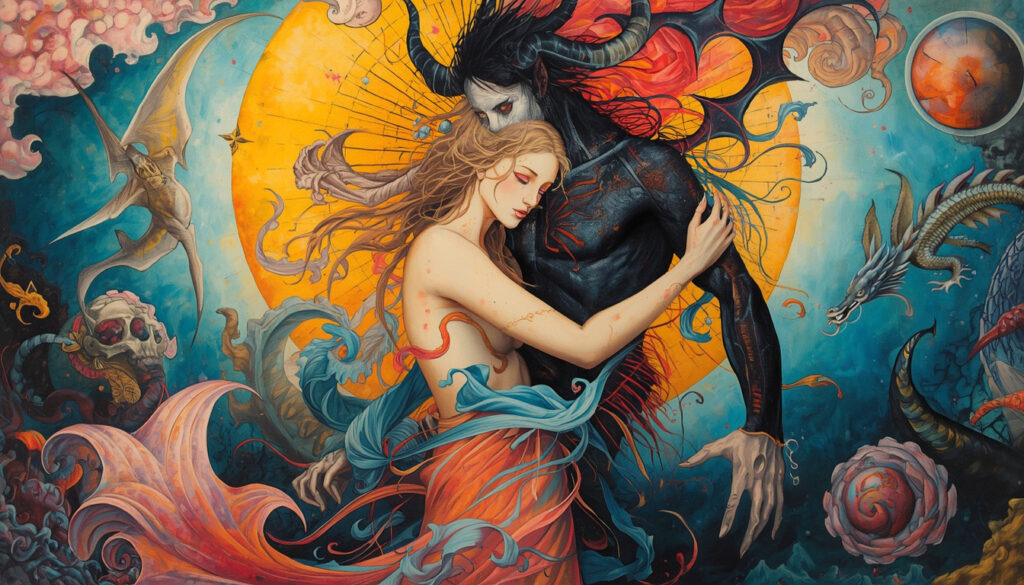
Good and evil sound like simple words until we try to define them. We use them easily in daily life. Helping a child is good. Betraying someone is bad. Everything looks clear.
Bet the questions arise when we try to look from another perspective.
Is a wolf evil when it kills a deer? Is a bacterium evil when it infects a body? Is a forest fire evil when it burns homes but renews the soil? Is the universe evil when stars explode, planets freeze, and species vanish without anyone noticing more than 4 light-years away?
Suddenly, good and evil do not look like solid moral objects just existing. They look more like judgments made from somewhere.
From inside a human life, some things are clearly good or evil. From inside a bacterial colony, those same things mean nothing of the sort. From the view of an ecosystem, death may be renewal. From the view of the universe, everything may simply be a transformation.
So maybe the real question is not only, “What are good and evil?” It is also, “For whom? At what scale? In relation to what?”
That is where the topic gets interesting. Also slightly irritating, as every proper philosophical question should.
The human meaning of good and evil
For human beings, good is usually connected to life, dignity, truth, trust, love, freedom, fairness, beauty, and the possibility of flourishing. We call something good when it helps a person become more alive in the deeper sense, not just breathing, eating, paying bills, and pretending to understand insurance documents.
Goodness protects the fragile conditions under which human life becomes meaningful.
Evil, on the other hand, is what destroys those conditions. It is cruelty, betrayal, humiliation, domination, unnecessary suffering, corruption of trust, and the reduction of a living person into an object. A person becomes evil not merely by causing harm, but by causing harm knowingly, carelessly, or with a polished refusal to see the other person as real.
That is why human evil feels different from natural harm. A falling rock can kill someone, but we do not put the rock on trial. A disease can destroy a life, but we do not call the disease morally guilty. Yet if a person knowingly poisons a river, lies to a population, humiliates someone weaker, or turns suffering into profit, something else enters the room. It is not only harm. It is harm joined with awareness, choice, intention, indifference, or self-deception.
That gives us one useful distinction:
- Harm can happen without morality.
- Evil begins when harm meets consciousness, choice, and responsibility.
Of course, even in human life the distinction is not always neat. A surgeon cuts flesh to heal. A parent may allow a child to struggle so they can grow. A soldier may kill in defense. A whistleblower may betray loyalty to serve truth. A lie may protect someone from immediate danger, while a truth may be delivered like a knife by someone who simply enjoys stabbing.
So good and evil cannot be reduced to pleasant and unpleasant. Sometimes good hurts. Sometimes evil smiles, wears clean shoes, and has a very convincing PowerPoint.
Bacteria and the collapse of moral drama
Now move downward in scale.
A bacterium does not wake up and decide to become a villain. It does not sit in a microscopic lair, stroking a microscopic cat. It metabolizes, adapts, reproduces, responds to chemical signals, and expands where conditions allow.
From the human perspective, pathogenic bacteria can be disastrous. They invade, multiply, inflame, poison, and sometimes kill. From the bacterial perspective, if we can even use that phrase, they are simply doing what life does: seeking conditions for continuation.
This is where human moral language starts to wobble. To us, an infection may be a tragedy. To the bacterium, it is a success. To the immune system, the bacterium is an enemy. To the ecosystem of the body, the situation may be in imbalance. To the universe, it is chemistry with ambition.
The bacterium is not evil because it lacks moral imagination. It cannot recognize the suffering of the host. It cannot ask whether its growth is fair. It cannot choose mercy. It cannot restrain itself out of compassion. The bacterium’s “good” is survival and replication. Its world is not moral, but functional.
And yet bacteria reveal something uncomfortable about us. Much of life is driven by appetite before it is refined by ethics. Growth, competition, expansion, consumption, defense, adaptation: these are ancient patterns. Humans did not invent them. We inherited them, then added language, shame, law, theology, and marketing departments.
The moral question begins when a creature capable of appetite also becomes capable of reflection. A bacterium consumes because it must. A human can consume, notice the cost, invent a justification, and continue anyway. That is where morality sharpens its little knife.
The body as a moral metaphor
The human body gives us a powerful image. A healthy organism is not a place where every cell is free to do whatever it wants. It is a living order. Cells grow, but within limits. They cooperate. They communicate. They specialize. They die when their death serves the whole.
Cancer is terrifying because it is life against life. Cancer cells are not dead matter. They are alive, active, and successful in their own narrow sense. They multiply, avoid regulation, claim resources, and refuse the discipline of the organism.
From the perspective of a single cancer cell, growth is victory. From the perspective of the whole body, that victory is a catastrophe.
This makes cancer a dark metaphor for evil. Evil may not always be pure destruction. Sometimes it is a local good that has broken away from the larger order. Appetite without relationship. Growth without limit. Freedom without responsibility. Power without proportion.
A selfish cell kills the body that sustains it. A selfish person can damage the community that made their life possible. A selfish civilization can exhaust the planet it depends on. Same melody, bigger orchestra, worse consequences.
In that sense, evil may be less like darkness and more like runaway partiality. Something good in its proper place becomes destructive when it declares itself the whole.
Nature beyond morality?
The natural world is full of things that look brutal through human eyes. Predators tear prey apart. Parasites control hosts. Chicks push siblings out of nests. Nature is not a wellness retreat.
But does this make nature evil?
Nature is violent, generous, wasteful, delicate, inventive, indifferent, and astonishing. It feeds life through death. The deer eaten by the wolf is tragedy for the deer, nourishment for the wolf, population balance for the forest, and material cycling for the soil. A forest fire destroys trees, animals, homes, and memories. It may also release seeds, clear diseased growth, and return nutrients to the ground.
At the ecological level, good and evil often become balance and imbalance.
- Too many deer can destroy a forest.
- No predators can weaken a population.
- No decay would trap nutrients.
- No death would eventually suffocate life.
This does not mean suffering is fake. The deer still suffers and humans who lose homes to floods are not comforted by being told that the water cycle is morally neutral. Only a philosopher with dry socks would try that.
But the ecological perspective forces humility. Nature does not divide reality into heroes and villains. It works through relationships, limits, cycles, hunger, death, renewal, and interdependence.
Yet human beings are now ecological agents on a planetary scale. That changes everything. A lightning fire is not evil. A corporation knowingly dumping poison into a river to save money is closer to evil, because knowledge and choice are present. A virus spreading through a population is not evil. Leaders lying about danger for personal gain may be. A predator killing prey is not evil. Industrial cruelty hidden behind convenient packaging deserves a harder look.
Nature may be beyond morality. Human behavior inside nature is not.
The universe and the silence beyond judgment
Now zoom out.
The universe does not appear to operate as a moral courtroom. Stars are born, burn, collapse, explode. Black holes swallow light with impressive commitment. Planets form, freeze or vaporize. Species emerge and vanish. The universe creates the conditions for consciousness, then gives consciousness disease, grief, entropy, and relatives with opinions.
From a cosmic perspective, good and evil may not exist at all. There is matter, energy, force, time, and change. There is no obvious moral applause when a child is loved, and no thunderbolt when a tyrant lies. The universe is not reliably poetic. It lets terrible people enjoy breakfast.
This silence can be disturbing. Some religious and spiritual traditions answer it by seeing moral order behind appearances. Others say the universe is not morally structured, and that is exactly why human morality matters.
If the cosmos will not guarantee justice, then justice becomes a human task. If the stars do not care whether we are cruel, then our care becomes more precious, not less. Goodness may be a local rebellion against cosmic indifference: temporary, fragile, doomed in the largest thermodynamic sense, but still real.
A garden does not defeat entropy forever. It still matters. A friendship does not stop death. It still matters. A just act may not rearrange the galaxies. It still matters.
The universe may be silent, but humans are not. That may be our strange dignity.
Philosophers on good and evil, without the museum dust
Philosophers have been chewing on this question for thousands of years. Some saw good and evil as cosmic realities. Others saw them as human judgments, social tools, psychological patterns, or results of ignorance. Here is the cleaner version, without turning the article into a marble hallway.
- Plato saw the Good as the highest principle: the source of truth, order, and meaning. Evil, for him, is linked with ignorance, disorder, and distance from the Good. In plain language: people do evil because they are confused about what is truly good. Plato would probably prescribe education, discipline, and fewer bad poets.
- Aristotle brought morality down to earth. For him, good means flourishing, or eudaimonia. A good human life develops virtue, courage, generosity, practical wisdom, and balance. Evil is often a failure of character: too much greed, too little courage, too much appetite, too little reason.
- The Stoics, including Epictetus, Seneca, and Marcus Aurelius, believed that good and evil live mostly in the will. External events like illness, poverty, insult, and death are not truly evil by themselves. What matters is how we respond. A storm is not evil. Your panic, betrayal, or selfishness during the storm may be.
- Augustine argued that evil is not a substance. It is a lack or corruption of good, like darkness as the absence of light. This avoids making evil into an equal cosmic power. Evil does not create in the deepest sense. It twists, empties, and damages what is good.
- Thomas Aquinas believed every being seeks some perceived good. Even a cruel person may seek power, revenge, pleasure, safety, or recognition. The problem is not desire itself, but disordered desire. Lower goods start ruling higher goods, and suddenly the soul looks like a badly managed committee.
- Spinoza saw good and evil as perspective-based. We call something good when it increases our power of living, and evil when it diminishes us. Poison is bad for the person it kills, but nature itself is not morally offended. This is one of the best lenses for bacteria, because what is bad for us may be good for another organism.
- Kant argued that morality requires rational choice. Good means acting from duty according to principles that could be universal. Evil appears when a rational being chooses selfishness over moral law. Bacteria, wolves, storms, and earthquakes are not evil because they cannot choose moral law. Humans can. Congratulations to us, guilt unlocked.
- Nietzsche attacked the whole good-versus-evil framework. He asked who creates moral values, who benefits from them, and whether “evil” is sometimes just a label placed on strength, difference, desire, or threat. He is useful because he makes us suspicious in a healthy way. When someone says, “This is evil,” we should sometimes ask, “According to whom, and why?”
- Schopenhauer saw life as driven by blind striving: hunger, desire, fear, reproduction, and survival. For him, suffering is built into life. Good appears through compassion, when a suffering being recognizes itself in another. Evil is egoism, cruelty, and the refusal to see another’s pain as real.
- Hannah Arendt gave us the phrase “the banality of evil.” She did not mean that evil is harmless. She meant evil can be ordinary, bureaucratic, thoughtless, and dull. It is not always a villain laughing in a castle. Sometimes it is a person doing paperwork, following orders, protecting a career, and not asking what the machine is doing.
- Simone Weil treated attention as morally serious. To truly see another person, especially someone vulnerable or afflicted, is already an act of goodness. Evil begins when we turn people into things, tools, obstacles, or background scenery.
- Hans Jonas argued that modern technology gives humans enormous power, so ethics must include the future, nature, and the survival of life. Our tools have become planetary, so our responsibility must become planetary too. In old times, one cruel person could harm a village. Now one bad system can harm generations. Lovely progress, naturally.
Religious and spiritual views, clearer and less tangled
Religions often ask a slightly different question from philosophy. Philosophy may ask, “What is good?” Religion often asks, “What is good in relation to the sacred, the cosmos, the soul, the community, and the final meaning of life?”
Here is a clearer tour.
Hindu traditions: good as dharma, order, and liberation
In Hindu thought, good and evil are often understood through dharma, karma, and cosmic order.
- Dharma means duty, right order, role, law, and proper way of being.
- Karma means actions have consequences, shaping the future of the soul and the world.
- Liberation means moving beyond ignorance and attachment toward spiritual freedom.
The Bhagavad Gita gives a famous moral crisis. Arjuna does not want to fight in a war against his own kin. Krishna tells him the issue is not simply “violence bad, peace good.” It involves duty, intention, attachment, cosmic order, and spiritual clarity.
That is uncomfortable, but serious traditions often are. They rarely fit on a motivational mug.
Buddhism: evil as ignorance, craving, and suffering
Buddhism does not usually treat evil as a cosmic devil-force. Harmful action comes from ignorance, craving, aversion, and delusion.
Good is what reduces suffering and leads toward awakening. Evil, or unwholesome action, is what deepens suffering and confusion.
This works beautifully with the bacteria question. A bacterium is not evil because it has no hatred, greed, or delusion in the human sense. A human can be evil because a human can cling, hate, deceive, and refuse awareness.
Buddhism basically says: before you fight evil in the world, please check the greed, fear, and fantasy factory inside your own head. Rude, but useful.
Jainism: reduce harm wherever possible
Jainism takes non-harm, or ahimsa, extremely seriously. Moral concern extends to animals, insects, plants, and even microscopic life.
This is one of the strongest traditions for challenging human arrogance. Life is not valuable only when it looks like us, speaks like us, or has a passport.
But Jainism also exposes the tragedy of living. To exist is to affect other life. Eating, walking, farming, cleaning, and breathing all disturb something. So the moral aim is not perfect innocence, because that is nearly impossible. The aim is awareness, restraint, simplicity, and reducing harm.
Confucianism: good as becoming properly human
Confucianism is less interested in cosmic drama and more interested in human relationships. Goodness means cultivating humanity, respect, responsibility, ritual, family care, social harmony, and moral character.
The key idea is ren, often translated as humaneness or benevolence.
A good person is not just someone with correct opinions. A good person becomes trustworthy in relationships: child, parent, friend, ruler, neighbor, citizen.
Mencius thought humans have natural sprouts of goodness. Xunzi thought humans need discipline and education to become good. Together they give a pretty realistic picture: we have moral potential, but also a talent for nonsense.
Daoism: beware rigid labels
Daoism looks at good and evil with raised eyebrows. The Dao is the deep Way of reality, beyond our neat categories. What seems bad may become good. What seems good may become bad. Weakness may outlast strength. Uselessness may save a life.
Daoism does not say morality is fake. It says reality is larger than our labels.
This is perfect for our scale question. Good for the wolf, bad for the deer. Bad for the tree, good for the soil. Bad today, useful tomorrow. Human judgment sees a slice and calls it the whole cake.
Shinto: purity, harmony, and reverence
In Shinto, the focus is often not sin in the Western sense, but purity, pollution, harmony, and reverence toward kami, the sacred presences in nature, ancestors, places, and forces.
Good means maintaining harmony and respect within a living sacred world. Wrongness appears as pollution, disruption, disrespect, or imbalance.
This gives nature a different feeling. A mountain, river, forest, or storm is not merely an object. It may be sacred, powerful, and worthy of respect. Not cute. Not harmless. Sacred.
Judaism: justice, covenant, and disciplined desire
Jewish thought often frames good and evil through covenant, law, wisdom, justice, and responsibility before God and neighbor.
Evil is not just being spooky and wicked. It is injustice, oppression, idolatry, betrayal, violence, and exploitation of the vulnerable.
A very human idea here is the tension between yetzer ha-tov and yetzer ha-ra, the good inclination and the evil inclination. The so-called evil inclination includes appetite, ambition, desire, and self-interest. It is not purely bad. Without it, people might not build homes, create families, work, or improve the world.
The issue is not desire itself. The issue is desire without wisdom, law, restraint, or responsibility.
Christianity: love, sin, and evil as corrupted good
Christianity often sees good through love, grace, humility, justice, and union with God. Evil is tied to sin, pride, separation from God, and the corruption of love.
Augustine’s idea matters here: evil is not equal to good. It is a distortion or lack of good. Pride turns proper selfhood into self-worship. Desire turns into domination. Justice turns into vengeance. Religion itself can turn rotten if love leaves the building.
At its best, Christianity sees goodness not as moral superiority, but as love of God and neighbor. At its worst, like any tradition, it can forget this and become very busy polishing its own halo.
Islam: justice, intention, and accountability
In Islam, good and evil are deeply connected to God, justice, mercy, intention, and moral responsibility. Human beings are accountable because they can know, intend, choose, and answer for their actions.
Good includes justice, charity, humility, truthfulness, mercy, and submission to God. Evil includes arrogance, oppression, cruelty, corruption, injustice, and forgetfulness of God.
A plague is not evil in the same way a tyrant is evil. One belongs to the mystery of creation and mortality. The other involves will, intention, and injustice.
Zoroastrianism: cosmic struggle between truth and lie
Zoroastrianism gives one of the clearest cosmic battles between good and evil. Good is linked with truth, light, order, and wisdom. Evil is linked with deception, destruction, corruption, and the Lie.
Human beings participate in this struggle through good thoughts, good words, and good deeds.
This is very different from Daoism or Spinoza. Here the universe is morally charged. Reality is not neutral. Every choice joins, in some way, the side of truth or the side of distortion. Dramatic, yes, but also motivating. Some mornings need drama.
African relational traditions: personhood through community
Many African traditions understand goodness through community, vitality, ancestry, balance, and relationship.
Ubuntu is often summarized as “I am because we are.” A person becomes fully human through other people.
Good strengthens dignity, mutual recognition, life, and community. Evil fractures the web: cruelty, humiliation, greed, betrayal, isolation, and denial of another’s humanity.
This challenges the modern fantasy of the totally independent individual. From this view, the self is not a sealed container. It is woven from relationships. Harm others long enough and you also deform yourself.
Indigenous traditions: right relationship with the living world
Many Indigenous traditions, though very diverse, emphasize reciprocity, kinship, land, balance, and responsibility to the more-than-human world.
Animals, rivers, forests, winds, ancestors, stones, and places may be understood not as dead objects, but as relations. Good means living properly within a web of obligations. Wrongness appears as greed, disrespect, imbalance, taking without giving, or forgetting one’s place in the living world.
This is especially important now. A human-centered morality asks, “Is this good for us?” A relational ecological morality asks, “Is this good for the web we belong to?”
The second question is harder. Naturally, that means we usually avoid it until the bill arrives.
The information perspective: evil as corruption of meaning
Human societies depend on trust, communication, memory, and shared reality. A promise is not a physical object, but civilization leans on promises. A law is written language backed by authority. Money is trust wearing a number. Reputation is social memory. Love itself depends on truthful recognition.
From this perspective, good creates coherence. It strengthens trust, truth, understanding, and a reliable connection. Evil corrupts information. It lies, manipulates, gaslights, deceives, propagandizes, confuses, and breaks the link between word and world.
Violence destroys bodies. Lies destroy the shared map by which bodies live together.
This is why propaganda is not merely “speech.” It is pollution of the moral nervous system. A society can endure hardship, but it struggles to survive when nobody trusts words, institutions, neighbors, evidence, or memory. When language rots, cruelty becomes easier. People can be renamed as pests, traitors, viruses, obstacles, or statistics. Once a person becomes a category, the conscience relaxes.
The bacterium harms without falsehood. Humans often prepare evil by first corrupting the story.
The technological perspective: old instincts, enormous tools
Technology does not create evil from nothing, but it amplifies human intention and indifference.
A cruel person with a stick can injure a few people. A cruel or careless person with algorithms, financial systems, surveillance tools, drones, biotech, or mass media can injure millions while sitting in a comfortable chair.
This is one of the great moral changes of modernity: the distance between action and consequence.
The further we are from the suffering we cause, the easier it becomes to continue. A person may not be able to look a hungry child in the face and take away food. But they may support a policy, optimize a system, follow an order, click a button, adjust a spreadsheet, or approve a process that does something similar at scale.
Modern evil often hides inside abstraction. It appears as efficiency, growth, security, engagement, optimization, shareholder value, national interest, or “just doing my job.” Arendt’s warning becomes sharper here. Evil does not always arrive with horns. Sometimes it arrives as a workflow.
This is why moral imagination must grow with technological power. Our tools have become planetary. Our instincts are still tribal. Our wisdom, on a good day, is catching up by bicycle.
The shadow perspective: evil inside the self
No discussion of good and evil is complete if evil is always placed somewhere else. That is the oldest trick in the human book, and frankly the book has terrible reviews.
Depth psychology, especially in a Jungian sense, reminds us that every person has a shadow: the rejected, denied, feared, and unintegrated parts of the self. Rage, envy, greed, vanity, resentment, desire for control, pleasure in another’s failure: these do not vanish because we declare ourselves kind.
In fact, the person who believes they are purely good may become especially dangerous. Their aggression disguises itself as righteousness. Their cruelty becomes correction. Their domination becomes care. Their revenge becomes justice. Their fear becomes purity.
This is how individuals and groups become capable of evil while feeling innocent. They project the shadow outward. The enemy is filthy, dangerous, inhuman, corrupt, demonic. Once all darkness is placed outside the self, violence against the outsider feels like hygiene.
So goodness requires more than nice ideals. It requires self-knowledge. A person must be able to say, “I too am capable of resentment, cowardice, self-deception, and cruelty.”
This does not make us worse. It makes us safer. The denied monster is much more dangerous than the recognized one.
A little humility is not moral decoration. It is a security system.
Beauty against absurdity
There is also an aesthetic dimension to good and evil. Some actions feel beautiful, even when painful. Courage has form. Mercy has grace. Honesty, when joined with tenderness, has clarity. A generous life seems spacious. It makes room for others.
Cruelty feels ugly. Betrayal has a spiritual bad smell. Manipulation deforms the atmosphere. Even when evil succeeds, it leaves the world smaller, meaner, more cramped. It may win the event and lose the shape of the soul.
This is not a strict argument, but it is a real human perception. We do not only calculate morality. We sense it. We feel that some acts harmonize life while others distort it.
Existential thought adds another layer. Maybe the universe has no built-in justice. Maybe no cosmic balance guarantees that goodness will be rewarded and evil punished. Good people suffer. Vicious people prosper. The rain falls on the just and unjust, and sometimes the unjust own better umbrellas.
But that does not make morality meaningless. It makes it more intimate and more urgent. If justice is not guaranteed, then justice must be made. If meaning is not handed down fully formed, then meaning must be lived into existence.
Good becomes a revolt against absurdity, not because it conquers the universe, but because it refuses to let cruelty have the last word inside the human heart.
So what are good and evil?
After all these perspectives, one answer would be too small. Good and evil may not be single substances. They may be different realities depending on the level of existence.
At the biological level, good means survival, adaptation, reproduction, and successful functioning. The bacterium wants to live. The immune system wants to defend. The cell wants energy. There is no moral guilt here, only life pressing forward.
At the ecological level, good means balance, renewal, resilience, and right relations among parts. Death may serve life. Predation may preserve health. Decay may nourish growth. Evil, if we use the word carefully, resembles imbalance: excess extraction, collapse of reciprocity, appetite without limits.
At the human psychological level, good means awareness, integration, compassion, courage, honesty, and the ability to recognize the reality of others. Evil means denial, projection, cruelty, domination, and the refusal to see.
At the social level, good means trust, justice, dignity, truthful speech, protection of the vulnerable, and conditions for flourishing. Evil means humiliation, exploitation, lies, corruption, and systems that make suffering invisible.
At the spiritual level, good may mean alignment with God, Dao, dharma, truth, love, sacred order, or the deep structure of reality. Evil may mean separation, disorder, ignorance, rebellion, imbalance, or forgetfulness.
At the cosmic level, perhaps good and evil disappear into transformation. Or perhaps, as some traditions insist, the cosmos itself is morally charged. The answer depends on whether we see the universe as a machine, an organism, a mystery, a battlefield, a divine expression, or a silent abyss.
But for humans, the most practical definition may be this:
Good is what protects and deepens the possibility of life becoming conscious, dignified, truthful, compassionate, and whole. Evil is what knowingly destroys, corrupts, or narrows that possibility when another path was available.
The phrase “when another path was available” matters. A shark is not evil for biting. A bacterium is not evil for multiplying. A storm is not evil for breaking a roof. But a person, group, institution, or civilization that can understand suffering and still chooses unnecessary destruction enters moral territory.
What do we do with this?
The first step is to stop using good and evil like cheap labels. They are serious words. They should not be thrown at every inconvenience, disagreement, or person who loads the dishwasher incorrectly, though that last one does test civilization.
The second step is to widen perspective without dissolving responsibility. Yes, morality depends on scale. Yes, nature is not a children’s story. Yes, many things that look evil from one angle are neutral or necessary from another. But this should make us wiser, not numb. Human cruelty does not become acceptable because galaxies collide.
Another step is to examine the shadow. The line between good and evil does not run only between groups, nations, religions, ideologies, or species. It runs through the human capacity to know and deny, to love and dominate, to see and refuse to see. A person who knows their own darkness is less likely to outsource it to an enemy.
And finally, perhaps goodness is not purity. Purity is too brittle for this world. Goodness is attention, restraint, courage, repair, proportion, reverence, and the willingness to protect life beyond the borders of the self.
We may not be able to make the universe morally neat. The universe does not seem interested in neatness. But we can make our corner of it less cruel, less false, less hungry for domination, and more capable of tenderness.
That may sound small beside exploding stars and endless galaxies. But for a human being, small is where morality lives.
There is an old kind of story, told in many forms, about a person who finds an injured animal by the road. A bird, a dog, a fox, it hardly matters. The animal is frightened, half-wild, and very inconvenient. Helping it will make the person late. It may bite. It may die anyway. No law of the universe demands that the person stop. The stars do not lean closer. The bacteria in the ditch continue their tiny empires. But the person stops.
For a few minutes, nature is interrupted by something strange: attention. A creature that could have walked past chooses not to. Nothing cosmic is solved. Suffering is not abolished. The universe does not become fair. But in that small act, the world becomes less cold than it could have been.
Maybe good is often like that. Not a grand victory over evil, not a trumpet blast from heaven, not the final correction of existence. Just a pause in the machinery. A refusal to let suffering remain completely unseen. A hand extended where no hand was required.
Evil, then, may begin when we train ourselves not to pay attention. And Good may begin in a little moment when we still do.
